
Iran has fallen*
*Even if it hasn't yet. The degree of violence the regime has had to use on protestors ends its legitimacy as a state. It is now a zombie regime, like North Korea, and will function only to survive.

Last week, a friend asked what I thought about the protests in Iran, which anti-Iranian accounts on X were hyping heavily.
Probably overstated, I said. The Islamic regime has faced repeated protests since 2009. Each time, security forces responded with violence from tear gas to bone-breaking assaults to rooftop snipers. Dozens of demonstators died, and thousands more were arrested and tortured, but the government’s foundations remained unshaken. Something similar would probably happen again, I said.
I was wrong.
—
(Because sometimes telling the truth means admitting a mistake.)
—
Since last week, the Iranian government has put Iran under a near-total news, telephone, and Internet blackout.
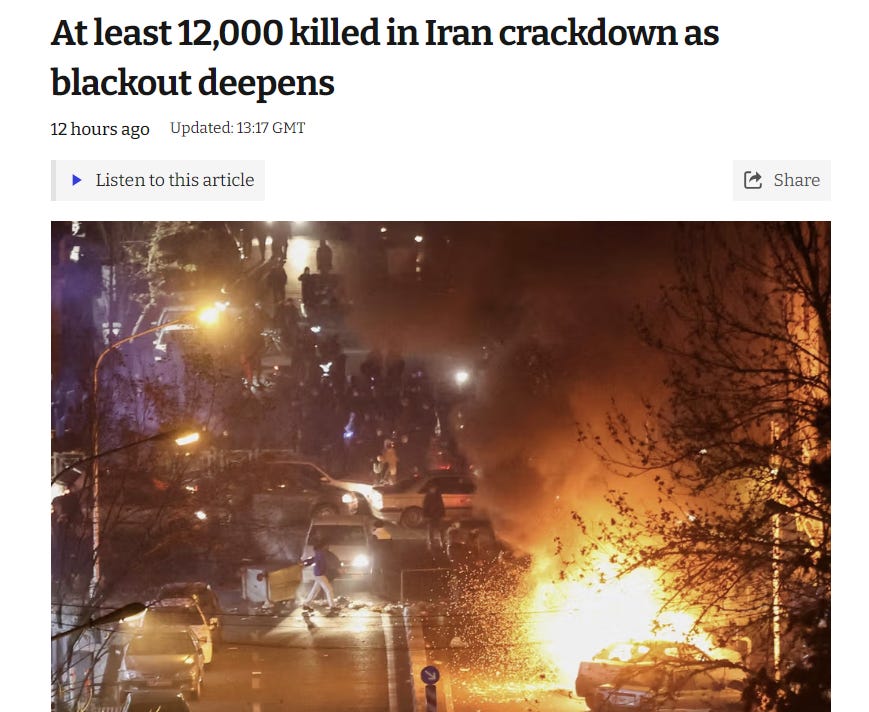
Still, enough fragmentary video has emerged to reveal that the protests — which began two weeks ago after Iran devalued its currency — have turned into a full-scale rebellion. Violent demonstrations and even more violent repression have spread across Iran, which has 90 million people and is more than twice the size of Texas.
No one knows how many Iranians have died at the hands, or bullets, of the regime. The New York Times put the figure at 3,000 dead today and reported that security forces were using machine guns on crowds. Iran International, which is an a reasonably reliable anti-regime group, reported Tuesday morning that 12,000 people had been killed. And the protests continue.
—
(Killing for Khamenei)
—
Whether the regime collapses in the next few days depends on several factors: whether the United States intervenes more actively; whether Russia or other countries offer asylum and safe passage to Iran’s top leaders; most importantly whether any senior leader or general has the power and the will to order the regime’s security forces and military to stand down.
If not, the demonstrations are likely to break after a while. Eventually even the most committed protestors get tired of being machine-gunned to death.
I don’t have any secret intelligence on what’s happening inside Iran’s government and whether the leadership is cracking, so I will not guess whether the regime will fall in the short term.
But trying to set a clock almost misses the point.
Whether or not the mullahs can shoot enough people to restore order, the Islamic Republic of Iran is dead. It may continue to exist, but it will have no legitimacy outside its own borders (and only a forced legitimacy within).
Autocrats and dictators can survive by marginalizing resistance, but in the era of modern communication and video, once a government begins killing unarmed protestors en masse, it has planted the seeds of its destruction.1
As of now, and for as long as the mullahs remain in charge, Iran is North Korea, a problem for the world to solve.
—
It’s worth remembering how Iran reached this moment.
Sanctions, mismanagement, graft, and overspending on the military and nuclear programs have left Iran’s economy in shambles for decades. And the economic strides that Saudi Arabia and Iran’s neighboring Gulf states have made have shown Iranians up close just how bad their leadership has been.
But the regime really began to shake when Israel assassinated Ismail Hamiyeh, the leader of Hamas, in Tehran in July 2024. The targeted killing showed how weak Iran’s security apparatus had become and set the stage for the successful Israeli and American attacks on Iran’s nuclear program last June.
I wondered at the time if the United States should have bombed Iran; I was wrong on that score too.
—
(Two wrongs in one article don’t make a right. But maybe they make a subscription?)
—
The Trump Administration and Israel clearly understood that Iran had become too weak to retaliate and that they could set the Iranian nuclear program back years without much risk. The possibility that embarrassing the mullahs would speed potential regime change was an added bonus.
Now here we are. For the sake of the protestors — and for the tens of millions Iranians caught under a theocracy they hate — let’s all hope and pray this zombie regime does not survive much longer.
China is the only (arguable) exception to this rule; the People’s Republic survived its violent crackdown of the Tiananmen Square protests in 1989. But the Tiananmen victims were mostly students. In addition, China is far larger than Iran and the protests were confined to Beijing. Finally, although the Communist Party remained in power, China radically revised its economic policies following Tiananmen.
Alex, quick question, how many regime change operations has the US orchestrated since 1947? How many have worked out from the US perspective? How many have worked out well from the affected nation's perspective? How did the first regime change in Iran in 1953 work out? Trace that one forward and you get to many Iraqis and Iranians killing each other for 8 years in the 1980s, each mostly armed by the US. I'm sure that the US is not involved in stoking these protests and I'm sure the Western media coverage is actuate. This looks like Ukraine in 2014, how did that one work out? Also, expect the Iranian response if the US gets directly involved to be far more dangerous theIR response in June 2025.
The Donroe Doctrine in effect.
The capture of Maduro is looking wiser and wiser every day. The dominoes are falling.
All these rogue states are connected.
For example, for decades, tge Iranians have been building missile factories in Venezuela, under the guise of tractor production. In 2022, they signed a 20-year cooperation agreement with Maduro that included additional arms sales, defense plants, and oil field technology.
The terrorists ecosystem is falling apart.