
Ebola! Eeeeebola!
Ebola's an awful disease, one of many awful diseases. Unlike most, it lets aid workers strap on Tyvek suits. No wonder it gets so much hype. Meanwhile, malaria kills 600,000 people a year.

Yesterday, the truth about measles. Today, Ebola.
AND PLEASE DON’T FORGET TO ORDER THE FATHERHOOD MANIFESTO. FOR TIP #17, about how to protect your kids from media panic porn, and all the others.
—
—
Richard Preston invented Ebola.
No, Preston isn’t a virologist with a thirst for blood. He isn’t a scientist at all.
But he’s the only reason you have ever heard of the Ebola virus — which kills a grand total of about 300 people a year globally, roughly the same number of Americans who died of overdoses each day in 2023.
In October 1992, Preston wrote a New Yorker article called “Crisis in the Hot Zone,” about an Ebola outbreak at a research laboratory in Virginia (even well-run virology labs sometimes have leaks, except in China, where they run perfectly all the time).
The article was real-world medical fearmongering at its best, and an instant sensation.
—
(The truth, even when it won’t scare you. For pennies a day)
—
Preston expanded it into a 1994 book also inevitably called The Hot Zone, which became a cultural event, back when books could still be cultural events.
This is largely because Ebola is a hemorrhagic virus and a nasty way to die (as opposed to all the fun ways). Preston leaned into the gory details: patients with blood pouring from their mouths (and other orifices) and even crying “tears of blood” — a detail even he has now admitted isn’t true.
If that wasn’t enough, Preston’s article even included the z-word:
The face becomes fixed and “expressionless,” “masklike,” “ghostlike” (in the words of doctors who have seen it), with wide, deadened, “sunken” eyes. The patient looks and sometimes behaves like a zombie...
—
(Actual picture of Ebola victim!1)

—
Now we have another Ebola outbreak, this one in the eastern Congo, which has been the scene of a low- to mid-grade civil war for decades.
About 600 cases and 127 deaths have now been reported.
The World Health Organization has declared a “public health emergency of international concern.” And all the usual headlines are popping up.
But.
But the same reason Ebola is so terrifying is the reason it can’t spread very widely.
Generally — not always but generally — viruses need to “choose” between lethality and transmissibility. Ebola is a good example of the principle.
Ebola’s natural animal host has never been definitively found, but scientists generally believe African fruit bats are the most likely reservoir. Occasionally, the virus jums to humans, possibly through bat bites or scratches. It may also spread from bats to secondary animal hosts that rural Africans then eat.
However it reaches humans, Ebola is highly lethal once it does.
The virus quickly causes a condition called “disseminated intravascular coagulation,” which doctors privately call “death is coming.” Tiny blood clots form throughout the body, but paradoxically severe bleeding follows. (It’s possible this modality is of particular interest to me today because I just finished donating blood, but I digress.)
—
Make a one-time donation! No need to give blood, money will do!
—
Ebola kills around half its victims, a coin flip no one would take.
But those victims decline very rapidly, and Ebola does not spread through the air. It is not the flu or Covid or measles. It requires direct contact with body fluids like blood, saliva, sweat, and vomit — or at a minimum touching clothes or bedsheets or other objects those fluids have contaminated.
This doesn’t mean Ebola cannot spread quickly, particularly early in an outbreak, when people in affected regions may not be aware of the danger. A lack of clean water and sanitation also raises the risks of an outbreak. So do African burial practices that include family members and friends touching, washing, and cleaning a corpse.
Again, though, Ebola is not a respiratory virus. Fairly simple infection control practices and quarantines will rapidly control its community spread.
But even simple infection control practices and quarantines can be hard to implement in African conflict zones with nonexistent government control. And Ebola is especially hard on African hospitals, which lack the specialized gear to protect doctors and nurses. So Ebola outbreaks in Africa can take months to burn out.
—
(All the usual headlines)
—
But burn out they will, with or without outside intervention, as they have in the five decades since scientists recognized Ebola as a virus. And as they no doubt did long before anyone ever identified Ebola as all.
Yes, most recent outbreaks have grown in size — alongside Africa’s population and population density, and in a post-colonial era with long-running civil conflicts and weak governments. Still, the total death toll for Ebola since 1976 now stands at roughly 15,500, just over 300 people per year.
By way of comparison, the Coast Guard reported 556 deaths in boating accidents in in the United States 2024.
And, again, we have simply no evidence Ebola would pose a significant or even minor risk in the United States, Europe, or any country with decent hospitals and basic sanitation.
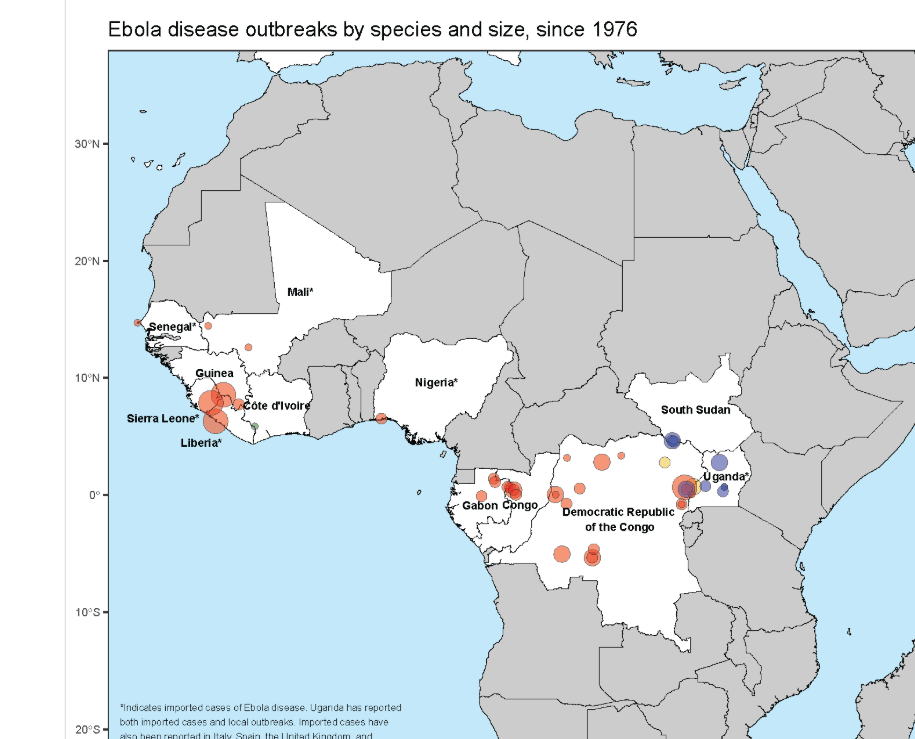
The CDC map of outbreaks in the last 50 years is basically a geographic version of unsafe at any speed, a handy guide to world’s most dangerous, unpleasant, and worst-run countries.
—
(Where’s Afghanistan when you need it?)
—
But Ebola deaths are nasty, as everyone now knows (thanks Richard Preston!).
And outbreaks give a chance for American and European health bureaucracies to show up at great expense — and for doctors and nurses to glove up, suit up, and prove their bravery, maybe saving a handful of very sick and very poor patients (and sometimes getting themselves infected too).
The patients are real, and the risk is real, so the outbreak responses aren’t exactly public health theater. Are they a good use of your tax dollars? Of course not. Standing up temporary hospitals in the world’s poorest countries for a disease that presents little or long-run risk is more or less the definition of wasting money.
Then again, so is spending $640 an hour (!) for “autism behavioral therapy,” and nobody went to jail for that.
It’s enough to make you cry blood. Metaphorically speaking, of course.
Too soon?
—
(Yep, I went there. Come with me!)
—
Not actual picture of Ebola victim, poster for super-scary zombie movie.
Thank you for providing reason and sanity once again.
Fear is the second most effective brainwashing tool (sleep deprivation is #1). The powers behind the scene have been running a brainwashing campaign for years, all to let us happily/anxiously give more control and money to the government. Remember when people said “bye” ending a phone call, instead of “be safe?”