

First off, thank you!
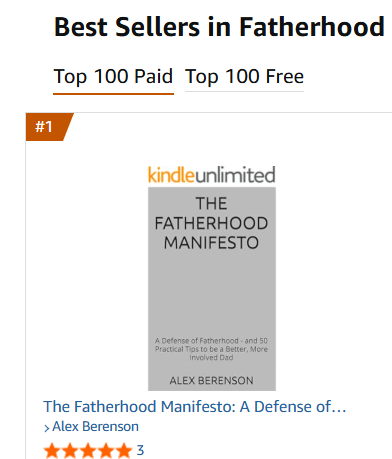
With just a couple of emails to you yesterday, THE FATHERHOOD MANIFESTO is off to a great start. It’s #513 on Amazon (out of, well, about 10 zillion). Not bad for a book with a grand total of two cover colors. (Keep it simple, dads.)
Please help keep the momentum going today! The paperback is now available for two-day free Prime delivery, or download the Kindle and read in seconds!
And if you buy it, please review it! Reviews spell engagement to Amazon, and Amazon likes engagement.
—
—
But forget The Fatherhood Manifesto (I know, impossible!) for a minute. Turn your attention to a book called Strangers, a best-seller since its release in January.
Imagine: a rich man meets a poor, beautiful woman. They marry, after signing a prenuptial agreement protecting his trust funds.
They have three kids. The man stays home and cares for them, while the woman works hard and becomes successful. As the kids enter adolescence, the marriage runs out of steam. The woman has an affair and demands divorce. The husband is devastated, but she will not reconsider.
She says she will not fight for custody of the kids. After all, the husband has taken care of them. Besides, they’re now teenagers, with the oldest one heading to college, so custody is mostly irrelevant.
The husband agrees — on one condition. The prenup protected his trust funds. It also said the income he and his wife earned during the marriage would remain separate unless they put the money into assets they held jointly.
He doesn’t think that deal is fair anymore. He wants to void the prenup. He wants 100 percent of both their houses — plus a share of the assets his wife earned with her work during the marriage. He also expects to keep his trust funds.
Yes, the wife cheated, ended the marriage, walked out on her family.
Even so, does this financial outcome really seem fair? Why should the husband get, for lack of a more felicitious term, all the moneys?
After all, he entered the marriage rich. Why should he also take most of the wealth his wife built by working long hours and weekends for two decades, while he took care of the kids (with plenty of household help)?
How many people would take his side?
—
This is a simplified story of Belle Burden’s marriage.
Only she’s the husband in it. She’s the one who entered the marriage rich but wanted extra money during the divorce.
In Strangers, Burden describes the collapse in 2020 of her marriage, an event she claims puzzles her to this day. Along the way she offers a deeply dishonest portrayal of her financial circumstances, as The New Yorker revealed in an investigation last month.
Burden claims in her memoir she feared losing both her homes, a loft in downtown Manhattan and large house on Martha’s Vineyard, unless her husband tore up their pre-nuptial agreement and gave them to her outright. It is unclear even in her telling why the properties might be at risk. She fails to note they were together worth about $20 million and had minimal mortgages, while Burden reported almost $1 million in income in 2019 alone.
But Burden’s financial misrepresentations run far deeper. As the New Yorker reported:
In the eventual divorce settlement, Burden is listed as a beneficiary of no fewer than five trusts. Apart from those trusts, [emphasis added] Burden’s net-worth statement, filed in December, 2020, showed that she had her own Vanguard account and a six-per-cent stake in WAMBCO [another family asset]; the combined value of the two exceeded ten million dollars. All of these resources would remain Burden’s alone in the divorce.
—
Support Unreported Truths with a one-time donation!
$10, or $10 million, it’s all good!
—
The New Yorker wrote that knowing the truth about Burden’s finances “complicates the narrative” of Strangers, a polite way of saying it turns her story into fiction.
Burden was not a poor wife at risk of losing her home to a greedy husband. She was a Harvard-educated lawyer trying to punish her unfaithful spouse in the simplest possible way, by turning his pockets inside out.
It’s not about the money, only it’s always about the money.
Ultimately, Burden mostly succeeded. Even though New York state courts threw out her effort to strike the prenup, her husband agreed to a settlement giving her his equity in both houses, plus child support totaling about $1 million a year. (The man wanted out. He has never commented publicly on the divorce or Burden’s book.)
Despite these inconvenient facts, the feminist-media-industrial complex has rallied to Burden’s side since the New Yorker article. As the Washington Post wrote Friday, “Questions have arisen about Belle Burden’s best-selling work and its suggestions about her finances, but female readers are defending it anyway.”
Their logic goes something like this: he cheated, he ended the marriage, so she gets whatever she likes!
—
(Putting “the law” in quotes is a nice touch.)

—
There’s just one problem.
Many of the same women defending Belle Burden the loudest are very much in the “follow your bliss, ladies, and if that means getting a divorce, you go girl” camp of feminism.
Including, well, Emily Gould, who wrote a long article BARELY TWO YEARS AGO about cheating on her husband and deciding whether to leave him. Ultimately, she didn’t — she just humiliated him still further by telling the world what she’d done. (Not making this up, though I truly wish I were.)
This theme has become so overt that there is now a mini-category of books about it. As an online literary magazine explained last November:
Now, more than ever, we also have divorce memoirs, a subset of which, written by women prioritizing happiness over staying in bad marriages, are hitting best-seller lists.
Yes, modern feminist vision seems to be that women should do whatever they like, including breaking up families, rather than stay with men they don’t love anymore. But any man who does the same deserves should be drawn and quartered.
The double standards here run so deep they aren’t standards at all.
—
(Keeping standards, no matter what.)
—
Divorce stinks. It stinks for everyone involved, and especially for kids. It is best avoided. And infidelity is wrong.
But I have no idea why Belle Burden’s husband was unfaithful, or what their marriage was really like. Apparently she doesn’t either. If she does, she never tells us. (Though, given her dishonesty about her financial situation, maybe she has a better idea than she is letting on.)
The problem isn’t really that Burden misrepresented her story. Divorce is the ultimate Rashomon puzzle. Expecting a betrayed wife to tell the truth about her husband is impossible.
The problem is the media’s believe all women response to the New Yorker’s article.
Our entire legacy cultural architecture now seems to exist to elevate women at the expense of men — a situation that has, unfortunately but understandably, led to an increasingly angry male answer, from Andrew Tate on down.
—
To come back to today’s theme… it is this dynamic that led me to write The Fatherhood Manifesto.
The devaluation of fatherhood is part of the devaluation of men and masculinity.
And it needs to stop. It’s bad for everyone, even the women who somehow think it helps them.
And, by the way, it is this dynamic that makes me sure getting mainstream publicity for TFM will be very difficult. So I hope you will bear with me as I promote it.
I don't understand this drive to publicly humiliate the other parent of your children. I'm divorced. I could tell some horrible stories. So could my ex-husband. Why would we open that can of worms?? Why would anyone want their children to know the worst parts of their other parent? Like it or not, your ex is your children's other parent. Half of your children is made up of that person. You better find something lovable in them, or resign yourself to having fucked up, self-hating kids with all the destruction that entails.
My father was maligned by my mother in perpetuity. The story is long and messy; I can't sound byte it, but he died when I was 18 (they separated when I was 11) so my mother's version [of Dad] was all I knew. In my 50s I visited my dad's family (aunts & cousins) after which my mother disinherited me. But when my dad's sister (my aunt) told me, "Your father really loved you..." a weight lifted off me and I inherited a father's love. All my life, I heard men were bad, my mother saying "I had to drag your father out of the bar to spend time with you..." This conflicted with memories of him teaching me to fish, shoot photos, go on backpacking trips, etc. It occurred to me that fathers don't spend time with children unless they WANT to. How did that square with my mother's bitter words? My mother spent my childhood invalidating my father's love; my aunts and cousins repaired it. My words to any "wronged" women out there: remember, he's your child's father. Unless he's an abusive dangerous criminal, he doesn't have to be perfect (hey, you aren't). He matters. Don't sever your child's relationship with him for your own selfish reasons. We (the children) are the collateral. Alex, I look forward to reading your book.