
Substack has lost its way
It was once THE place for contrarian thinking and reporting. Now nearly all its biggest newsletters/podcasts serve conventional liberal/woke pap. Is that really its future?
Back in the day — and by back in the day, I mean about four years ago — being on Substack meant something.
It meant you gave people news or analysis the legacy media didn’t. Often, it meant you didn’t have a media background at all. You had a day job, and a point of view you wanted to share, because the media wasn’t.
It meant you viewed your job on Substack as being a writer first and foremost, not a podcaster or an influencer or a YouTuber or a television personality.
It meant you appreciated, and maybe needed, Substack’s commitment to free speech and hosting for unpopular (usually meaning conservative) views.
And it meant you had a voice distinctive enough to survive on your own, without a media company’s help.
Now? Not so much.
—
(Help me Make Substack Great Again)
—
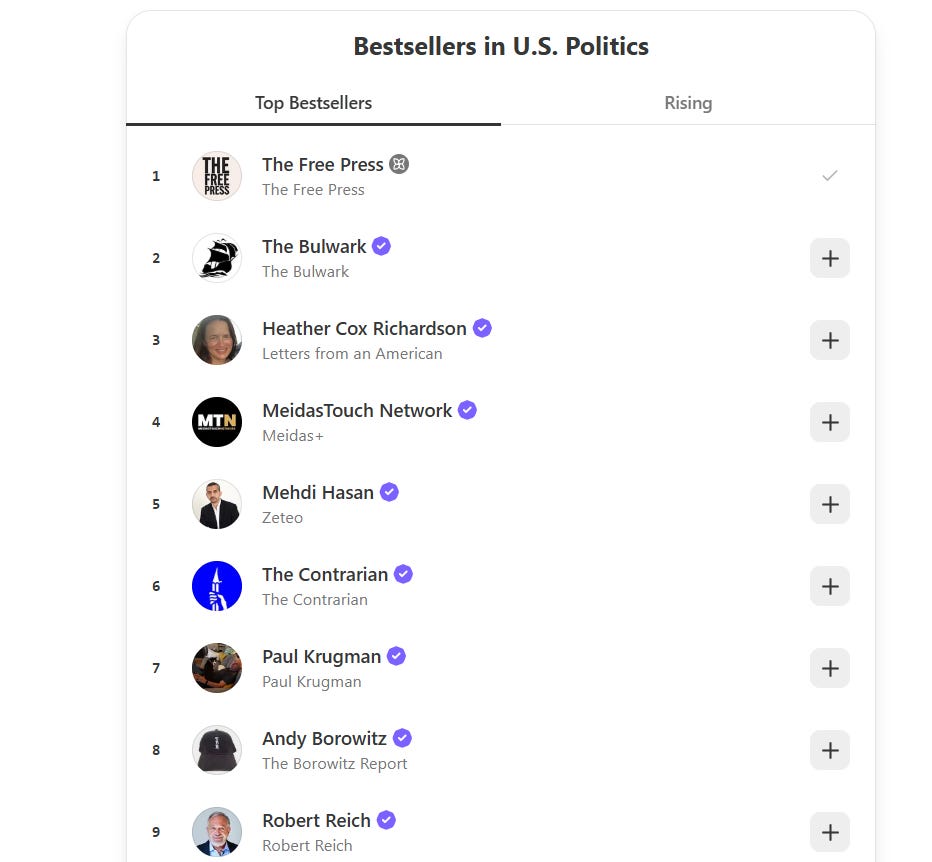
Substack ranks its most popular newsletters on “leaderboards.” (Unreported Truths is currently #5 on “Health Politics,” just after Dr. Joseph Mercola.) The most important leaderboard is “U.S. Politics,” which has by far the most “purple-check” accounts, those with over 10,000 paid subscribers.
The top “U.S. Politics” account is The Free Press, from Bari Weiss, an independent-to-conservative outlet that is undoubtedly the platform’s biggest success story.
But the next eight biggest U.S. Politics accounts now fall on the liberal/woke/progressive spectrum (including “The Bulwark,” which calls itself centrist but in fact suffers from terminal Trump Derangement Syndrome — its lead “story” today has the sarcastic headline Trump Mentals Strong. Like Nothing You’ve Ever Seen. Vietnam.)
Nate Silver, a truly independent voice, ranks tenth. Then the leftist chorus continues, with nine of the next 10 Substacks somewhere between super-liberal and, well, even more liberal than that. Matt Taibbi is the sole exception.
—
(Hide your eyes)
—
The politics shift has come with a second painful change: Substack is now increasingly filled with people who aren’t particularly interested in writing. I don’t mean bad writers, like Paul Krugman. I mean people who view the platform as a place for podcasting or video, delivered through an app.
The people who made the most of Substack 1.0, like Taibbi, Andrew Sullivan, even Heather Cox Richardson (a Massachusetts historian who was the first and arguably only organic liberal success story on Substack), built their audiences as writers.
So what’s happened?
Substack began with a very simple value proposition. It offered an easy-to-use newsletter creator and email engine along with an seamless link to Stripe. The combination was well worth the 10 percent fee Substack charged, especially for people like me, who needed a reliable (meaning non-censoring) host. Yes, Substack’s cut grew along with the audience. But most individual writers never grew so big that the 10 percent really mattered. Even those who did generally weren’t interested in trying to move a big audience.
—
—
Could Substack have stuck with a simple 10-percent-of-newsletters-business?
I don’t know. Other newsletter publishers charge less (one is trying to recruit me right now), although Substack still has a better brand than they do.
Either way, though, Substack wanted — and wants — to grow. It believes it can only survive as a media company by pushing podcasting and video offerings and encouraging readers and writers to use its app and its X-like “Notes” feature.
But the podcast and video business is both expensive and very competitive. You may have heard of a little company called YouTube (itself part of Alphabet, nee Google). On the right, Rumble is a $3 billion publicly traded company, while X has a massive audience for hosts like Tucker Carlson.
So, perhaps inevitably, Substack has gone left.
The problem, of course, is that leftist podcasting and video tends to be… what’s the word I’m looking for… hold on, it’ll come to me…
Boring.
Ahh, that’s it. Boring beyond belief. Aside from the momentary anti-Trump fervor of Donald Trump’s first term, Fox has destroyed MSNBC and CNN for a generation. Left-leaning comedians have largely ruined late night, ceding almost everyone under 50 (60?) to podcasters like Joe Rogan.
The original Substack had two unquestioned success stories: The Free Press and, yes, Heather Cox Richardson’s Letters from an American. Both were newsletters that turned into something more — but still remain centered around writing.
At the same time, Substack became known for its free-speech philosophy, which was very appealing to people like me — and a draw for readers. Not everyone knew what Substack was, but those who did knew what the brand stood for: free speech. Anyone who didn’t like it was welcome to whine about Nazis and leave. And individual writers could do just fine with a couple of thousand paying subscribers.
What does the Substack brand stand for now?
Endless interchangeable lefty podcasters who want to be the next Joe Rogan but are burning cash fighting over Substack’s audience base, which is tiny compared to other video hosts?
—
(You know what brand hasn’t changed? This one! Subscribe to Unreported Truths and get, well, the truth. For pennies a day.)
—
Meanwhile, the conservative and independent thinkers and writers who made Substack different than the New York Times or other legacy media outlets are harder and harder to find, and Substack does less and less to promote them.
Maybe Substack will be able to make the leap into something like a left-wing Rumble. The company discloses very little about its growth or finances. Its last update on paid subscribers in March 2025, when it said it had passed the five million paid subscriber count. It had been announcing each one-million-subscriber milestone before that (it passed four million in November 2024), but it has been quiet since then. Does that mean its growth has stalled south of six million paid users? I don’t know.
What I do know is that Substack’s fizz has faded. Three years ago, Elon Musk wanted to buy Substack and make it part of X. Today, I suspect he couldn’t care less.
And that’s a problem all the boring liberal newsletters in the world can’t solve.
None of that ‘growth’ on the left is organic.
I mean seriously. Is there a single person who subscribes to UT that believes Robert Reich organically grew his Substack form zero to over 1 million subscribers in just a couple years.
Or that he has 10,000+ paid subscribers (some independent sites put that number north of 100,000) who pay to read his drivel.
C’mon man. They’ve been bought off.
It’s been memory holed now. But one of the first things Doge discovered was that the Bidan adminstration (and I’m sure it didn’t start there) was paying for 10s of 1000s of subscriptions to the NY Times, WaPo, LA Times, Politico, Axios etc.
There are deep pockets behind many of these high sub left wing hacks. And probably deep state pockets as well.
Alex, the people who still want good content like yours on Substack can find it, regardless of what management promotes. The key point is the commitment to free speech, as you discussed in a previous post. Are you going to call them out about that?