

I first heard about NAD in 2021 at Joe Rogan’s studio in Austin.
Back then, Joe (or his insurers) insisted guests take a rapid Covid test before the show. As we awaited the results, his nurse asked me if wanted “a NAD shot.”
I did not know what a NAD shot was, I only knew I didn’t want one. The nurse seemed nice, but maybe Joe figured a tripping guest would amp up the show? Better safe than sorry.
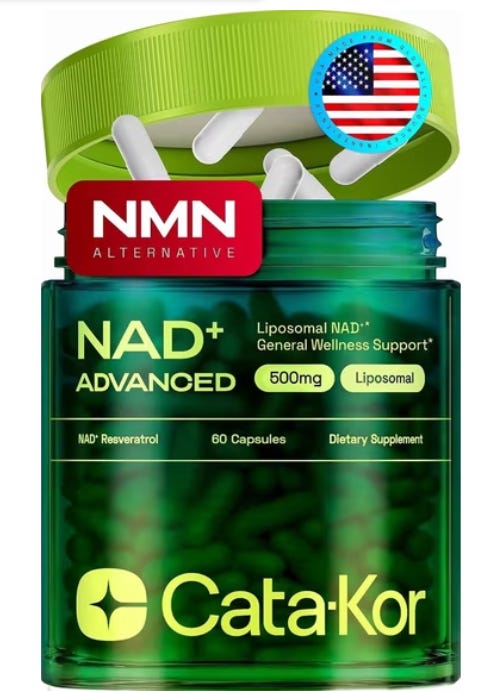
I checked later and discovered NAD was not a hot new psychedelic but a natural enzyme called nicotinamide adenine dinucleotide. NAD doesn’t require a prescription and is highly popular with anti-aging gurus. It’s not cheap. Retailers like Walmart sell it in jars of 60 capsules for $40. Online pharmacies ship $100 vials for injection. Wellness centers offer it in infusion “drips” at up to $1,500 a session.
Naturally (or unnaturally), wellness influencers like Brian Johnson and Gwyneth Paltrow can’t get enough of NAD.1 In January, Paltrow told Elle magazine she takes NAD drips and also has “a great little NAD+ pen where you can give yourself a shot when you need a boost. It’s fantastic.”
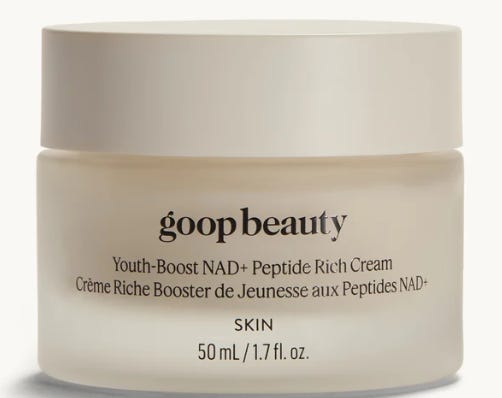
You will be shocked — shocked — to hear Paltrow’s Goop brand offers a “Youth-Boost NAD+ Peptide Rich Cream” for the low, low price of $105 per 50-milliliter jar. (Monthly deliveries get 10 percent off!).
—
(Not selling anything but the truth. Please support me.)
—
Two actual facts have driven this boom.
First, NAD is a vital enzyme. It helps cells metabolize nutrients and repair DNA. As the Cleveland Clinic explains:
NAD helps your cells make energy by carrying electrons from one chemical reaction to another. This process powers nearly everything your body does, and it keeps your cells working properly…
Second, some studies have shown NAD levels fall with age or conditions like Parkinson’s disease.
Thus a simple and compelling theory was born: if age and illness caused declines in NAD, raising NAD would reverse age and illness!
—
(The capsules are escaping the bottle, that’s how excited they are to fix you!)
—
Unfortunately, like so many simple and compelling medical theories, the NAD-as-fountain-of-youth argument has turned out too good to be true.
The first big hit came in May, when a team of Dutch researchers published a letter in Nature Metabolism showing that blood levels of NAD do not fall with age or rise with exercise. The finding cut to the core of the pro-NAD case.
Still, NAD advocates argued the finding is not definitive, because other studies show that NAD levels fall in muscle and brain cells, though those studies are smaller and weaker than the Dutch results.
But an even more worrisome report came last week, when Norwegian scientists published the results of a year-long trial of nicotinamide riboside (NR) in people with early-stage Parkinson’s disease. (The body converts NR into NAD, so the study was effectively a study of NAD.) The study was randomized, placebo-controlled, and blinded, the gold standard for medical research, and published in the Journal of the American Medical Association.
It found that the NR patients actually had worse disease after a year than those who received placebo, and the difference was large enough to be statistically significant, meaning that it was not likely to be due to chance.
Meanwhile, in a little-noticed paper in February, researchers tracked the effects of NAD and NR infusions on healthy patients — and found that those who received NAD reported “moderate to severe gastrointestinal symptoms, increased heart rate, and chest pressure during infusions.” They also had decreases in HDL (good) cholesterol after 30 days.
—
(When the font is this classy, you know it works! Plus it’s in French too. Two languages equals twice as effective.)
—
The problem, as always, is that human biology in general and the biology of aging in particular are incredibly complex.
Even if NAD does decline naturally with age (and the Dutch study suggests it does not), artificially raising it won’t necessarily reverse those effects. In fact, a 2025 paper suggested increasing NAD actually led to more inflammation and arterial plaques in mice.
At this point, no one should be taking NAD for Parkinson’s. It’s actively contraindicated. The same probably applies to other brain diseases like Alzheimer’s.
If I were taking it for anything else, I’d also stop. Influencers like Paltrow have argued essentially that even if they don’t have proof NAD helps, it’s a naturally occurring enzyme and taking it can’t hurt. But these new studies suggest they may be underselling its dangers.
And first, do no harm applies to dietary supplements as much as anything else.
—
(Doing no harm, with your help.)
—
Is Joe’s helpful nurse still offering guests NAD? Sadly, I do not know, since he has not had me on since 2023. I miss you, Joe!
I'm into herbs. Herbs are natural. You still need to know what you are doing. Natural substances can hurt you if used in excess, inappropriately, or mixed with other medications. Do your research. Be cautious.
Also, what's with the whole fountain of youth stuff? We all get older and are going to die some day. Trying to keep healthy is good. But forget the obsession with youth and enjoy your life!
I must have needed a "NAD boost" yesterday because I got tired. Arose at 3 AM, packed the pickup with tools, drove 160 miles to location, installed an alternator on a Kubota engine (those Japanese must have small hands) in 90 degree heat, did multiple other chores while the engine ran for three hours, drove 160 miles back and got in at 6 PM. Then showered and took the wife out for a bite to eat. At almost 79 I just don't have the energy I used to have but I think I will pass on this NAD stuff after reading Alex's article and stick with the supplements my wife has researched and provides.