

This morning’s piece questioning why the media is so obsessed with measles deaths has generated lots of feedback already. Generally I like to let readers debate without getting too involved, even when I disagree. Tussling one-on-one with you seems unfair, considering I get to write the stories!
But in this case, a reader named Neil Muller raised a question on the broader value of the measles vaccine worth a direct answer. I responded in the comments section, but I think the discussion merits a separate email, since most of you may not see it there.
So: his comment and my answer are below, unedited.
—
(Want to join Neil in the comment section? Subscribe! Only paid subscribers can comment.
—
Neil’s comment:
I generally like your coverage.
But I am less concerned about the points scoring and more about the underlying issue. What in fact is the cost benefit of measles vaccination. You still seem to lean towards vaccination. This may in fact be the correct approach. But how many serious side effects are prevented by vaccination (as opposed to cases) and what are the side effects of vaccination?
I grew up in a high socio-economic group (white South African) and no one was vaccinated. No one really was afraid of measles. It was viewed as a common relatively mild disease that was better to get when you were young becuase getting it when an adult was viewed as serious.
And as far as I know, serious cases decline as incomes, sanitary and water infrastructure and diets improve. In socialized medicine systems they use quality adjusted life years to measure the cost effectiveness of treatments. I wonder what the cost of each qaly would be in order to justify the costs of vaccination (both direct and indirect).
—
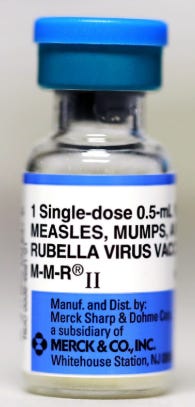
(Such a pretty vial, so much fighting)
—
My answer:
A fair question. But it seems clear that even in wealthy countries the measles death rate in kids is in the 1 in 1000 to 1 in 2000 range (depending on how frequently SSPE occurs - and SSPE [subacute sclerosing panencephalitis, an always-fatal brain disease that occurs in a small number of children several years after they contract measles] is horrible). (Some pro-vaccine people put the number of deaths as high as 3 in 1000.)
And measles is contagious enough that everyone who is not vaccinated will get it - or would, without the free-riding benefits of herd immunity. So if the vaccine didn’t exist, and everyone got measles, roughly 1500 to 3000 American children per year would die of measles.
Is that a plague? No. But it a FAR higher death toll than the flu or Covid causes in kids, and the vaccine has essentially eliminated it, with real but minor side effects. At 90-95 percent vaccination rates, we don’t see those deaths, because herd immunity is real and unvaccinated kids mostly do NOT get measles, which is why people can try to argue against the vaccine.
But overall, the vaccine’s cost-benefit ratio is clear. That’s why, when I discuss it, I try to make clear that what truly bothers me is not the vaccine itself but the relentless push to get from, say, 93 percent to 95 percent vaccination rates and the lies and politicization and parental shaming that have become a part of that push.
—
What do you think? As always, comments are open below! (Subscribe here to join the fray…)
The problem is the death rate you cite is incorrect. It's a sleight of hand used by the CDC.
They calculate the ratio at 1 in 1000 by using only reported cases. In the linked CDC document you'll see that reported cases were about 500 000 annually before the vaccine was introduced in 1963 and the number of deaths at 400-500 per year. The estimated total cases were 3 to 4 million. Most cases were mild enough that they were treated at home and weren't reported. If you calculate the death rate with the estimated total cases it comes out to somewhere between 1 in 6000-8000. This is a really different figure than 1 -3 in 1000. But it's the accurate figure.
Add to this that these were the numbers in 1963 and over the 20th century deaths from measles were in steep decline. Humans were co-evolving with measles and dealing with it better and better. Given that, numerous doctors in the early 60s didn't think a vaccine was a good idea and parents were not asking for one. Is it reasonable to think that had a vaccine not been introduced the death rate would have continued to fall? Is it possible the introduction of the vaccine could lead to a loss of the natural herd immunity humans had developed over many generations?
Beyond that Vitamin A status is critical in recovering from measles and even the WHO says supplementation with Vitamin A can cut measles deaths in half.
Part of why it's been so difficult to have a real risk benefit analysis of vaccines is that this level of consideration has historically been viciously denied air time. The CDC obfuscated and the media formed a cone of silence. I'm grateful for forums like this where it can finally happen.
https://www.cdc.gov/measles/downloads/measlesdataandstatsslideset.pdf?fbclid=IwY2xjawUFSaxwZG9mBWV4dG4DYWVtAjExAGJyaWQRMUdoeHJhUXNVV3BLR3ZxREFzcnRjBmFwcF9pZBAyMjIwMzkxNzg4MjAwODkyAAEeo_rzix0O0ehEYUcoBoir94WB37cM_TKEBoDpivWlVmqgdy6c_L1gxx0tvh4_aem_3noArn9xfr9drTqWA04i_w
President Trump was right to push for separation of the three components. It is the combination, as well as the adjuvants (which should be removed) that cause the most inflammation, reactions and probably the deaths (which continue to far exceed deaths from measles). When I worked as a nurse in public health in Lancaster County, PA, we had an outbreak of Rubella and a smattering of birth defects among the unvaccinated Amish women. Rubella during pregnancy is particularly risky (and it should be noted that we are currently talking about Rubeola in PA) and if the vaccine components were separated and proven to be safe, the unvaccinated might be more amenable to taking them.