

I just posted this on X. It belongs here too, though with more context, in brackets (best to keep posts short on X, readers there have the attention span of squirrels):
Okay, I have to be the skunk at the medical garden party (I am ALWAYS the skunk at the medical garden party).
This newly approved pancreatic cancer drug [daraxonrasib, which the Food and Drug okayed Wednesday] is a modern medical miracle, an unbelievable scientific triumph. [The drug is the first-ever KRAS inhibitor, attacking a gene mutation that drives tumor growth. It is the product of decades of research, and many oncologists believed that KRAS proteins could never be successfully targeted.]
As a society, we better hope it doesn't work. (It doesn't work nearly as well as the hype makes it seem.)
Why?
It's priced at $500,000 a year. [Technically $39,800 a month, or about $478,000 when patients take daraxonrasib for a full year, per Revolution Medicine, which developed it. What’s $22,000 between friends?]
—
(The perspective you can’t find anywhere else. For way less than $478,000 a year.)
—
It is only ONE medicine that these patients will have to take, by itself it extends life moderately, about six months.
[Randomized open-label clinical trials showed that pancreatic cancer patients given daraxonrasib in addition to chemotherapy died, on average, after 13 months. Those who received chemotherapy alone lived just under 7 months. These patients had already received previous treatments, so their prognosis was grim; daraxonrasib may offer a larger survival advantage as a first-line treatment, though we will not know unless and until clinical trials are completed.]
The average age at diagnosis for pancreatic cancer patients is 71.
Let's say we manage to combine this drug and two others into a cocktail that extends life for these patients by five years; that cocktail will likely cost $1 million a year.
[This, unfortunately, is not an unreasonable estimate; Merck’s Keytruda now costs up to $210,000 a year and is the world’s top-selling drug, with $31 billion in sales last year. The Moderna mRNA “cancer vaccine” will likely cost much more per patient, if it actually works.]
67,500 Americans get pancreatic cancer every year.
Do we plan to spend $300 billion a year - 1 percent of US GDP - keeping a relative handful of retirement-age Americans alive for a handful of years? That's an insanely bad use of societal resources, and the only reason we don't have to face it for real is because the drug doesn't work nearly as well as the media hype makes it seem.
—
(Approximate cost of one year of daraxonasib treatment. Don’t lose any pills!)
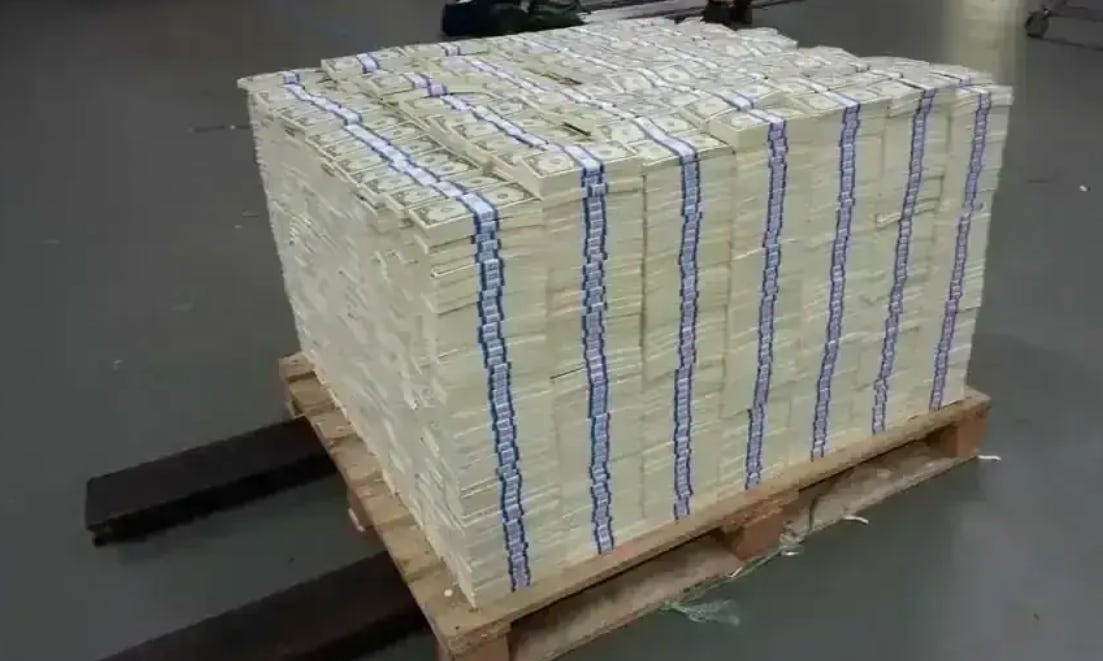
—
People will take the drug, live a few extra months, and die. A handful will live longer. That's great for them and their families, it's great for science, but it doesn't change the fact modern American medicine is a cash-eating machine in ways that make no sense societally.
Hey, at least this drug actually works.
You think that skunk smell is my cynicism. It's actually pallets of cash being set on fire.
The other end of the equation (see Canada, Holland, and Belgium) is that Grandma gets too expensive, so we just put her down. Or a depressed twenty-year-old is too expensive (or has too valuable organs?), so they get put down as well.
But you're right, Alex. Cost definitely should be part of the discussion. And we need to discuss this!
Pancreatic cancer killed my mom at age 72. No way a drug which would prolong her life six months is worth $500k. Doubt it’s worth $50k.